Aqua Pilates: Why Exercising in Water May Be the Smartest Workout After 40

Discover how Aqua Pilates uses the natural properties of water to build strength, protect your joints, and support healthy aging
Aqua Pilates is changing the way people think about low-impact exercise. By combining the controlled movements of traditional Pilates with the natural support and resistance of water, it offers a workout that can build strength, improve balance, increase flexibility, and challenge your core—all while placing far less stress on your joints than many land-based exercises.
Whether you’re recovering from an injury, looking for a gentler way to stay active, managing joint stiffness, or simply looking for a smarter way to stay active as you get older. Aqua Pilates offers something many traditional workouts can’t.
Best of all, you don’t need to know how to swim. Most classes take place in shallow, chest-deep water where you can comfortably stand throughout the session.
Movement doesn’t just feel easier in water—it changes how your body works during exercise.
In this article, we’ll explore the science behind Aqua Pilates, explain why exercising in water is so effective, compare it with traditional Pilates, and discover why it can be a particularly valuable form of exercise for staying strong, mobile, and healthy throughout the midlife transition in both women and men.
Table of Contents
What Is Aqua Pilates?
Aqua Pilates is a form of exercise that combines the principles of traditional Pilates with the natural properties of water. Instead of exercising on a mat or reformer, participants perform slow, controlled movements in a swimming pool, usually in chest-deep water.
The focus remains the same: improving core strength, posture, balance, flexibility, and body awareness—but the water changes how every movement feels by supporting your body while constantly challenging your balance and stability.
Unlike traditional Pilates, where gravity is the main force your body works against, Aqua Pilates uses the resistance of water to challenge your muscles. Every movement meets gentle resistance in all directions, encouraging your muscles to work continuously while placing much less strain on your joints.
A typical class includes breathing exercises, core activation, balance work, strength training, and stretching.
If you’re just getting started, look for an Aqua Pilates class in your area to learn the basic techniques. Once you’re familiar with the movements, you can continue practicing at your own pace in any suitable swimming pool using simple equipment such as a pool noodle or foam dumbbells.
One of the biggest advantages of Aqua Pilates is that it can be adapted to suit almost any fitness level. Beginners, older adults, people recovering from injuries, and experienced exercisers can all work at their own pace because the water naturally adjusts to the effort you put into each movement. The faster or harder you move, the greater the resistance becomes.
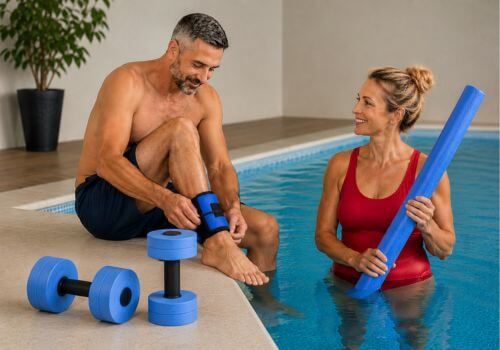
All you need is a pool, a pool noodle, and a pair of foam dumbbells to perform a wide variety of effective movements. For more advanced exercises, you can also use buoyant ankle weights (also called ankle floats), which add extra resistance by floating upward in the water and challenging your leg and core muscles.
This flexibility makes Aqua Pilates an excellent choice for anyone with access to a swimming pool, as well as for those who don’t have Aqua Pilates classes in their area.
Although Aqua Pilates shares some similarities with swimming and water aerobics, its emphasis is very different. Rather than focusing on laps or fast-paced cardiovascular exercise, Aqua Pilates prioritizes controlled movement, proper alignment, stability, and mindful breathing—the same core principles that have made Pilates popular for more than a century.
Because the resistance comes from the water itself, each exercise can be as gentle or as challenging as you choose, making it suitable for beginners and experienced exercisers alike.
Why Water Changes Everything
At first glance, exercising in a swimming pool might not seem very different from exercising on land. But water behaves very differently from air, changing the forces acting on your body with every movement. That’s why an exercise that feels relatively easy on land can feel surprisingly challenging in the water—and why movements that might be uncomfortable on your joints often become much more comfortable in a pool.
The secret lies in three unique properties of water: buoyancy, hydrostatic pressure, and natural resistance. Together, these forces create an environment that supports your body while constantly challenging your muscles, balance, and coordination. The result is a workout that feels gentle on your joints yet can still improve strength, stability, and overall fitness.
Let’s take a closer look at how each of these properties works and why they make Aqua Pilates such an effective form of exercise.
Buoyancy: Why Your Joints Get a Break
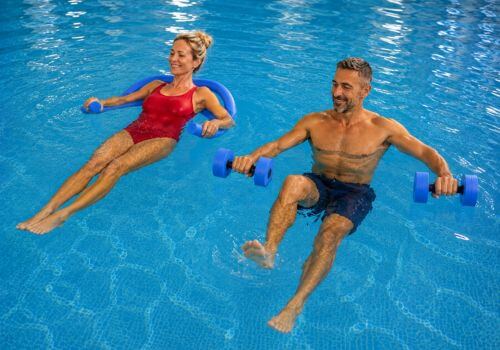
One of the biggest advantages of exercising in water is buoyancy—the upward force that helps support your body. The deeper you stand in the water, the lighter your body becomes. In chest-deep water, your joints may carry only a fraction of your normal body weight, reducing the stress placed on your knees, hips, ankles, and spine.
This doesn’t mean you’re getting an easier workout. Instead, buoyancy allows you to perform movements that might feel uncomfortable or even painful on land with greater ease and confidence. Squats, leg lifts, and balance exercises often become much more accessible because the water supports part of your weight while still allowing your muscles to work.
For people living with arthritis, joint stiffness, back pain, excess body weight, or those recovering from an injury, this reduced impact can make exercise feel less intimidating and more enjoyable. It also allows many people to move through a greater range of motion, helping to improve flexibility and mobility over time.
Another important benefit of buoyancy is that it can help reduce the risk of exercise-related injuries. Because water supports much of your body weight and cushions your movements, there is less impact on your joints and less force placed on muscles, tendons, and ligaments. If you lose your balance, the water also slows your movement, making falls less likely and helping you exercise with greater confidence.
For women during menopause, buoyancy can be especially welcome. As declining estrogen levels can affect muscles, joints, and connective tissues, exercising in water provides a comfortable way to stay active without placing unnecessary strain on the body.
Hydrostatic Pressure: The Hidden Force Working Around Your Body
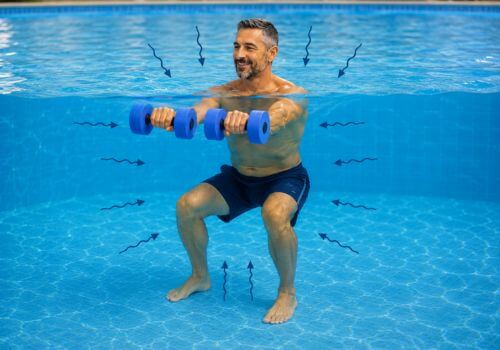
While buoyancy supports your body from below, hydrostatic pressure works all around you. As soon as you step into the water, it gently presses against your body from every direction, creating a natural, even pressure that you don’t experience when exercising on land.
This gentle compression may help improve circulation by encouraging blood to return to the heart more efficiently. Many people also find that it helps reduce mild swelling in the feet and ankles after standing or sitting for long periods, making water-based exercise feel particularly comfortable.
Hydrostatic pressure also provides your body with constant sensory feedback. As the water moves around you, your brain is continually receiving information about your body’s position, encouraging your muscles to make tiny adjustments to maintain balance and stability. This process helps improve body awareness, also known as proprioception—your body’s ability to sense where it is in space.
Better proprioception can support everyday activities such as walking on uneven ground, climbing stairs, or reacting quickly if you lose your balance. These improvements become increasingly important as we get older because maintaining good balance helps support confidence, mobility, and independence.
Unlike compression garments, which only apply pressure to certain parts of the body, water surrounds your entire body evenly. Every movement you make works together with this natural pressure, creating a unique environment that supports both movement and stability at the same time.
Natural Resistance: Your Invisible Weights
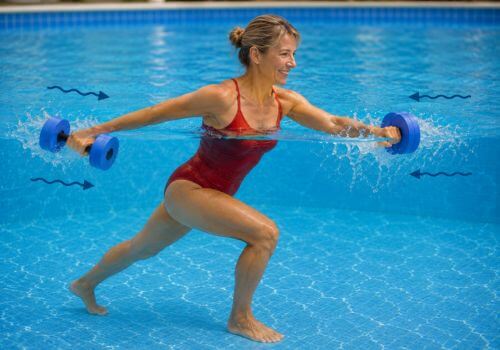
Unlike lifting weights in a gym, where resistance comes from dumbbells or machines, Aqua Pilates uses the natural resistance of water.
Every time you move your body through the water, the water pushes back. Simple equipment, such as foam dumbbells, also adds an extra challenge. Although they weigh almost nothing on land, their buoyancy makes them want to float in the water, so your muscles have to work harder to push them down and keep them under control.
This means your muscles are working throughout the entire movement, both as you move through the water and as you return to the starting position.
One of the unique advantages of water is that the resistance automatically adapts to your effort. Move slowly, and the resistance remains gentle. Move faster or push harder, and the water immediately pushes back harder. This means there’s no need to keep changing weights or adjusting complicated equipment—your workout naturally matches your fitness level.
Because water provides resistance in every direction, opposing muscle groups often work together to control and stabilize each movement. This helps develop balanced strength, improves coordination, and encourages better posture, while placing much less stress on the joints than many traditional forms of strength training.
Regular resistance exercise is an important part of maintaining muscle mass as we age. Strong muscles not only make everyday activities easier but also help support healthy bones, improve balance, and contribute to a healthy metabolism. Maintaining muscle strength becomes particularly important during midlife, as the natural decline in estrogen in women and testosterone in men can contribute to muscle and bone loss.
Although Aqua Pilates is an excellent way to build strength and improve muscle endurance, it works best as part of a well-rounded exercise routine. Combining water-based exercise with regular weight-bearing activities, such as walking or strength training, provides the greatest overall benefits for long-term bone, muscle, and cardiovascular health.
Why Aqua Pilates Is an Ideal Midlife Workout
As we move through midlife, our bodies naturally begin to change. Muscle mass gradually declines, joints may become stiffer, balance can become less steady, and recovery after exercise often takes longer than it did in our younger years. Hormonal changes in women during perimenopause and menopause, and the gradual decline in testosterone in men, can contribute to these changes.
For many people, this means that workouts they once enjoyed may suddenly feel uncomfortable or leave them with aching joints and sore muscles. As a result, it’s not unusual to become less active just when regular movement becomes even more important for maintaining strength, mobility, and independence.
This is where Aqua Pilates can make a real difference. The buoyancy of the water helps reduce the impact on your joints, while its natural resistance encourages your muscles to work without the need for heavy weights. At the same time, the constantly moving water challenges your balance and stability, helping to strengthen the muscles that support everyday movement and reduce the risk of falls.
Regular exercise during midlife plays an important role in maintaining muscle mass, supporting bone health, protecting cardiovascular health, and preserving mobility.
Perhaps one of the greatest benefits of Aqua Pilates is that it makes exercise feel achievable. Because movements are supported by the water, many people find they can move with greater confidence, making it easier to stay active consistently—one of the most important factors for supporting healthy aging.
If finding time to exercise is one of your biggest challenges, our latest research article explores whether completing the same total amount of weekly exercise in one longer session may provide similar improvements in body composition and fitness as spreading it across three shorter workouts.
Aqua Pilates vs Traditional Pilates: What’s the Difference?
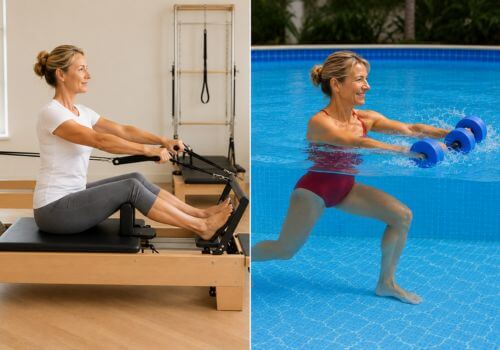
Although Aqua Pilates is based on the same core principles as traditional Pilates, the experience is quite different. The biggest difference is the environment. Instead of working against gravity on a mat or reformer, your body works with the support and resistance of water.
This changes how your muscles respond, reduces the impact on your joints, and makes many movements feel more accessible while still providing an effective workout.
Both forms of Pilates aim to improve posture, core strength, flexibility, balance, and body awareness. Neither is “better” than the other—they simply offer different benefits depending on your fitness level, goals, and any physical limitations you may have.
| Traditional Pilates | Aqua Pilates |
| Performed on a mat or reformer | Performed in chest-deep water |
| Gravity provides the main challenge | Water provides natural resistance in every direction |
| More pressure on joints during some movements | Buoyancy helps reduce pressure on joints |
| Stable exercise surface | Constantly changing water challenges balance and stability |
| Resistance comes from springs, body weight or equipment | Resistance automatically adapts to how fast and forcefully you move |
| May be difficult for some people with joint pain or injuries | Often more comfortable for people with joint stiffness, arthritis or recovering from injury |
| Suitable for all fitness levels | Suitable for all fitness levels, including many beginners and non-swimmers |
Ultimately, the choice doesn’t have to be one or the other. Many people enjoy combining both forms of Pilates, using traditional Pilates to build precision and control on land while turning to Aqua Pilates for a joint-friendly workout that adds the unique benefits of exercising in water.
What Happens During an Aqua Pilates Class?
If you’ve never tried Aqua Pilates before, you might be surprised by how calm and unhurried a typical class feels. Rather than fast-paced movements or high-impact exercises, the focus is on slow, controlled movements that encourage good posture, proper breathing and precise muscle activation.
Most classes begin with a gentle warm-up to help your body adjust to the water and prepare your muscles and joints for exercise. This is usually followed by breathing exercises and simple movements to activate your core muscles before gradually progressing to exercises that improve strength, balance, coordination, and flexibility.
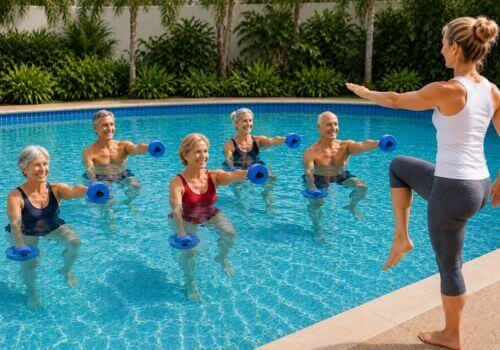
Many people enjoy joining a class because it provides expert guidance, motivation and the opportunity to socialize with others. However, you don’t have to attend a class to enjoy the benefits of Aqua Pilates. Once you’re familiar with the basic techniques, you can practise at your own pace in any suitable swimming pool.
There are also plenty of instructional videos online to help you learn new exercises and build your confidence. As your skills improve, you can gradually add new movements and increase the challenge at your own pace.
Depending on the class—or your own workout—you may use simple equipment such as inexpensive foam dumbbells or a pool noodle, although many exercises rely solely on the natural resistance of the water. Instructors often provide different options for each exercise, allowing beginners and more experienced participants to work at their own level.
Most sessions finish with gentle stretching and relaxation, helping to improve flexibility while allowing your heart rate to return to normal. Many people leave feeling refreshed and energized rather than exhausted, making Aqua Pilates an enjoyable form of exercise that can easily become part of a regular fitness routine.
Who Can Benefit from Aqua Pilates?
Aqua Pilates is suitable for almost anyone, regardless of age or fitness level. Because the water naturally supports your body while providing gentle resistance, the exercises can be adapted to suit beginners, experienced exercisers and people returning to activity after a break.
You may find Aqua Pilates particularly beneficial if you:
- want a low-impact way to improve your fitness
- experience joint stiffness or arthritis
- are recovering from an injury (with your healthcare provider’s approval)
- want to improve your balance and coordination
- are looking to strengthen your core without placing excessive strain on your back
- are going through midlife hormonal changes, including menopause or andropause
- want to maintain muscle strength and mobility as you get older
- simply enjoy exercising in the water
- are living with osteoarthritis and looking for a low-impact way to stay active (always follow your healthcare professional’s advice)
One of the greatest strengths of Aqua Pilates is that there is no pressure to keep up with anyone else. Because the water automatically adjusts the resistance to your movements, everyone in the pool can work at an intensity that feels comfortable for them while still benefiting from the workout.
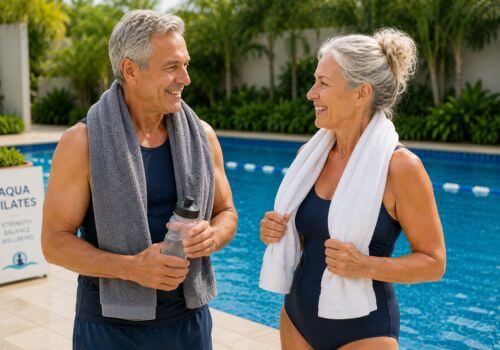
Whether your goal is to stay active, support healthy aging, recover from an injury or simply try something new, Aqua Pilates offers a gentle yet effective way to move your body with confidence.
When Should You Speak to Your Doctor First?
Aqua Pilates is generally considered a safe, low-impact form of exercise for most people. However, it’s always a good idea to speak to your doctor or another qualified healthcare professional before starting any new exercise programme if you have an existing medical condition or are unsure what’s appropriate for you.
It’s particularly important to seek medical advice if you:
- have recently had surgery or are recovering from a serious injury
- have severe osteoporosis or a high risk of fractures
- have uncontrolled heart or lung disease
- experience dizziness, fainting or balance problems that could increase your risk of falling
- have an open wound, skin infection or contagious illness that makes swimming inadvisable
- are pregnant and have been advised to limit physical activity
If you’re new to Aqua Pilates, start slowly and listen to your body. It’s perfectly normal to feel your muscles working in new ways, but you should never exercise through sharp pain or persistent discomfort. As your strength and confidence improve, you can gradually increase the intensity of your workouts.
For most people, Aqua Pilates offers a safe, enjoyable and sustainable way to stay active. By working within your own limits and progressing gradually, you can enjoy the many benefits of exercising in water while helping to reduce the risk of injury.
Lillepin Takeaway
Aqua Pilates combines the proven principles of Pilates with the unique properties of water to create a workout that’s gentle on your joints yet surprisingly effective. Whether you join a class or practise on your own, it’s a simple and sustainable way to stay strong, mobile and active throughout midlife and beyond.
Frequently Asked Questions
What is Aqua Pilates?
Aqua Pilates combines the principles of traditional Pilates with the natural support and resistance of water. It helps improve strength, balance, flexibility, posture, and core stability while placing less stress on the joints.
Is Aqua Pilates suitable for beginners?
Yes. Aqua Pilates is suitable for all ages and can be adapted to all fitness levels, allowing beginners and experienced exercisers to work at a pace that suits them.
Do I need to know how to swim?
No. Most Aqua Pilates classes take place in chest-deep water where participants can comfortably stand, so swimming ability is not usually required.
What equipment do I need for Aqua Pilates?
Most classes use simple equipment such as a pool noodle and foam dumbbells. As you progress, buoyant ankle floats can be added, although many exercises require no equipment at all.
Is Aqua Pilates good for arthritis and joint pain?
Yes. The buoyancy of the water reduces stress on the joints while allowing you to strengthen muscles and improve mobility. If you have a medical condition, speak to your healthcare professional before starting.
Can Aqua Pilates help during menopause or andropause?
Yes. Aqua Pilates helps maintain muscle strength, improve balance, support mobility, and keep you active during the hormonal changes that occur in midlife.
Can Aqua Pilates help with weight loss?
Aqua Pilates can help burn calories, build muscle, and improve overall fitness. For the best results, combine it with a balanced diet and other forms of regular physical activity.
How often should I do Aqua Pilates?
As often as you like. Most people benefit from two or three sessions a week, but you can enjoy Aqua Pilates more frequently if it fits your lifestyle and recovery needs.
Can I do Aqua Pilates at home?
Yes. If you have access to a swimming pool and have learned the correct techniques, you can practise many Aqua Pilates exercises at your own pace using simple equipment.
Is Aqua Pilates better than traditional Pilates?
Neither is better—they simply offer different benefits. Traditional Pilates uses gravity and spring resistance, while Aqua Pilates uses buoyancy and water resistance to provide a low-impact, joint-friendly workout.
Related Lillepin Research
P1-098 → Read the full article: Could One Workout a Week Be as Effective as Three?
NS-023 → Read the full article: Creatine After 40: Could It Protect Your Muscles and Boost Your Brain?