Medium-Length Beard Grooming 101: A Man’s Essential Guide

Keep the Shape. Lose the Scruff.
A medium beard is the sweet spot of facial hair: full, versatile, and long enough to develop a distinctive shape. But more length also means more to manage. The sides can puff out, the underside can become heavy, and a few stubborn hairs can start making their own styling decisions.
Keeping it sharp takes more than running the same trimmer guard over everything. You need to manage proportions, soften the hair where necessary, and preserve a shape that suits your face.
In Part 1, we covered grooming tips for stubble and short beards. In this part, we focus on medium-length beards—roughly 1–3 inches (2.5–7.5 cm) for this guide, although beard-length categories vary. From choosing a flattering outline to balancing cheek and neckline volume, here’s how to keep your beard deliberate, comfortable, and manageable.
Medium Beards: Soften, Shape and Maintain
Once your beard has enough length to develop its own shape, grooming shifts from simple length control to managing bulk, texture, and structure.
The aim is a silhouette that works with your face and your hair’s natural direction. A neat beard doesn’t have to be perfectly straight, and every hair doesn’t need to be exactly the same length.
Focus on three things:
- Comfortable skin underneath.
- Hair that feels manageable rather than rough or tangled.
- A balanced outline from the front, sides, and underneath.
Choosing a Medium Beard for Your Face Shape
Your face shape can help you decide where to keep fullness and where to reduce it. Think of these suggestions as starting points, not rules. Your coverage, texture, and preferred style matter just as much.
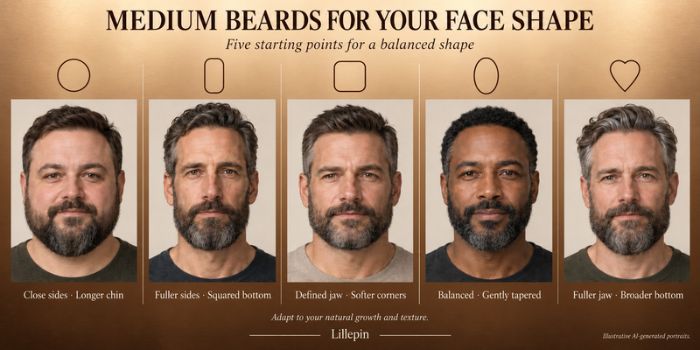
| Face shape | A useful starting point | What to watch |
| Round | Keep the sides relatively close and leave more length toward the chin | Too much cheek volume can make the face look wider |
| Long or rectangular | Retain some fullness at the sides and choose a rounded or squared bottom | A long, pointed chin can exaggerate facial length |
| Square | Follow the jaw’s structure, rounding the lower corners if you want a softer finish | Strongly angular trimming can emphasize an already prominent jaw |
| Oval | Try rounded, squared, or gently tapered outlines | Let your growth pattern and maintenance preferences guide the choice |
| Heart-shaped or pointed chin | Keep some fullness around the lower jaw and choose a broader bottom outline | A narrow, pointed beard can draw more attention to the chin |
Choose the Outline Before You Trim
Decide whether you want a rounded, squared, or gently tapered finish before picking up your tools.
- Rounded: A curved lower outline that works with the beard’s natural fullness.
- Squared: A broader bottom with more defined corners.
- Gently tapered: Closer sides leading into greater length toward the chin.
Check the shape at a normal viewing distance. A beard can look perfectly even close to the mirror yet too wide or too pointed when you step back.
Work with the coverage you have. If your cheeks grow less densely than your chin, a slightly lower natural cheek line may suit you better than trying to create fullness where little hair grows.
Bald Head, Medium Beard: Getting the Balance Right

A bald or closely shaved head and a medium beard can make a strong combination. With less hair on top, the beard becomes a prominent part of your overall look, so its proportions and sideburn transitions deserve attention.
Decide How the Sideburns Should Finish
Two approaches can work:
- A gradual taper: The sideburns become progressively shorter as they approach the shaved scalp.
- A defined endpoint: The beard finishes at a deliberate boundary beside the ear.
Choose the finish you prefer, then keep both sides consistent. A barber can establish a taper if you’re unsure how to blend it yourself.
Balance Width and Length
Use your face shape to guide the beard rather than assuming a shaved head requires a particular style.
Closer sides with more chin length can give a rounder face a longer appearance. Fuller sides with a less elongated bottom can help balance a long face.
You don’t need a huge beard to make the combination work. A controlled medium beard can provide plenty of definition.
Check the Whole Profile
Look at the scalp, sideburns, cheeks, and beard together. Coordinate scalp grooming with beard touch-ups so the overall finish stays intentional.
The goal is a combination you like—not spending every morning trying to recreate a barber’s photograph. A shaved head also leaves more skin exposed, so don’t forget to apply sunscreen to the scalp, ears, and other easily missed areas.
A Lean Daily Routine
A medium beard needs regular care, but your bathroom shelf doesn’t need to resemble a grooming department.
- Cleanse: Work a gentle cleanser through the hair to the skin underneath. Rinse thoroughly with lukewarm water and pat dry with a clean towel.
- Moisturize and condition as needed: Reach the skin with suitable moisturizing care, and use a hair-conditioning product if your beard needs help with softness or tangles.
- Detangle: With a smooth-toothed comb, ease out knots at the tips first, gradually working closer to the roots.
- Arrange: Set the beard into its usual shape with your fingers or comb. Add a small amount of balm only if you need hold.
- Inspect: Check the cheeks, moustache, and lower outline. Inspection doesn’t mean cutting every day.
The American Academy of Dermatology emphasizes caring for the skin beneath the beard and choosing products according to skin type. For sensitive skin, fragrance-free moisturizing care may be especially useful.
The Tools and Products You Need
Choose tools that suit your length and products that solve an actual problem.
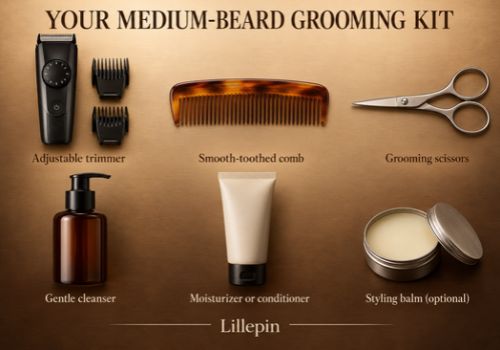
Your Essential Grooming Kit
- Adjustable beard trimmer: For shorter sections, sideburns, and controlled bulk reduction. Check its maximum cutting length before buying.
- Smooth-toothed comb: For detangling, arranging the beard, and guiding small cuts.
- Small grooming scissors: For individual strays, the moustache, and areas too long for your trimmer’s guards.
- Gentle cleanser: For the beard and skin beneath it.
- Suitable moisturizer or conditioning product: Chosen according to your skin and hair needs.
- Styling balm, optional: For flyaways and extra hold.
At the longer end of a medium beard, an ordinary trimmer guard may be too short to preserve your chosen length. Scissors—or a barber’s help—may be more useful than repeatedly running a short guard through the whole beard.
But beard or no beard, every man should have a simple grooming kit with the essentials for everyday care.
Moisturizer, Conditioner, Oil and Balm: What’s the Difference?
These products have different jobs, although formulas vary.
| Product | Main purpose | When it may be useful |
| Facial moisturizer | Moisturizes the skin beneath the beard | When dryness or skin comfort is your main concern |
| Beard conditioner | Softens hair and helps with manageability | When the beard feels rough or tangles easily |
| Beard oil | Adds lubrication and shine to the hair | When you prefer an oil-based grooming finish |
| Beard balm | Helps arrange hairs and provides some hold | When stray hairs need more styling control |
Check whether a conditioner is designed to be rinsed out or left in. They are not interchangeable.
You don’t need oil, conditioner, and balm simply because they exist. Start with what addresses your beard’s needs, use small amounts, and add another product only if it serves a purpose.
For acne-prone skin, the AAD recommends a non-comedogenic beard conditioner rather than beard oil. Product choice should follow your skin’s response, not just the promise on the bottle.
Drying and Setting the Shape
Before deciding what needs trimming, see how your beard sits when it’s dry and arranged as you normally wear it.
Pat gently with a towel rather than rubbing back and forth. Detangle carefully, then allow the beard to settle into its usual shape.
If you use a hairdryer, choose a low heat setting, keep it moving, and avoid holding it close to the skin. Use gentle combing to guide the hair rather than pulling it straight under tension.
Follow the instructions for your chosen conditioner or styling product. Once the beard is dry, reassess its outline before reaching for scissors.
A strand that looked unruly while damp may sit perfectly well once the beard has settled.
Shape and Execution
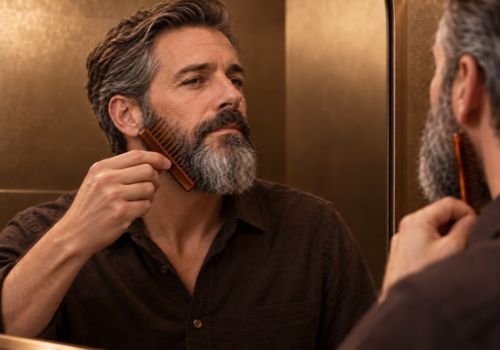
1. Comb First, Cut Second
Always arrange your beard into its natural daily style before trimming.
A hair sticking out may need to be combed into place rather than cut off. Follow your natural texture instead of trying to force every wave or curl perfectly straight.
If you normally use balm, check the styled outline—but avoid loading the beard with heavy product before a trim. You need to see how the hair sits, not flatten it into a temporary shape.
2. Balance the Cheeks and Sides
Cheek fullness affects how wide your beard looks from the front.
If the sides puff out beyond your preferred shape, reduce small amounts from the outer silhouette. Keep checking both sides instead of finishing one completely before starting the other.
For the cheek line, begin by tidying isolated hairs above your natural growth. Don’t keep lowering the line in pursuit of perfect symmetry; slightly different growth on each side is normal.
Leave enough fullness to support your chosen shape. Cutting the cheeks too close can create an abrupt contrast with a much heavier chin.
3. Preserve the Neckline and Under-Jaw Volume
The neckline is the boundary on the skin beneath your beard. The lower outline is the shape formed by the hanging hair. With a medium beard, these are not necessarily the same line.
Look straight ahead with your head in a natural position before deciding what to remove.
- Tidy hairs outside the established neckline.
- Avoid carving the neckline upward into the beard’s underside.
- Check the side profile before reducing bulk beneath the jaw.
- Keep enough under-jaw fullness to connect the sides and chin.
Tilting your head far back can make it tempting to remove hair that contributes to the beard’s shape when your head returns to its normal position.
If you’re unsure where the neckline should sit, have a barber establish it and show you which areas to maintain.
4. Trim Without Losing Your Shape
Trim when your beard is dry and sitting as you usually wear it. Decide whether you want to maintain length, reduce bulk, or tidy the outline before starting.
- For length control: Use a guard that can preserve your target length. Begin longer and shorten gradually.
- For bulk reduction: Make small adjustments to overly full areas, checking the overall silhouette after each pass.
- For outline detailing: Use scissors on isolated hairs extending beyond the shape.
- For longer sections: Avoid using a guard that would remove more length than intended. Ask a barber to demonstrate suitable scissor work if needed.
A medium beard usually benefits from different lengths in different areas. Running one guard everywhere can erase the proportions you’ve worked to create.
5. Keep the Moustache Manageable
Comb the moustache into its usual position before trimming.
For a neat lip line, carefully remove hairs that hang over the upper lip. If you’re growing a fuller or swept moustache, preserve the length needed for that style and trim only what interferes with eating or drinking.
Take small amounts and check both sides. One enthusiastic snip can change the whole expression.
Mistakes That Ruin a Medium Beard
- Cutting before combing: Arrange the beard first so you can see its actual outline.
- Using one short guard everywhere: This can remove the length and fullness needed for your chosen shape.
- Removing too much bulk at once: Make small adjustments and reassess.
- Trimming while wet: Wait until the beard is dry so you can judge how it normally sits.
- Yanking through knots: Work gently from the tips upward rather than pulling through tangles.
- Using too much oil or balm: Excess product can leave the beard looking greasy or heavy.
- Chasing perfect symmetry: Step back from the mirror before making another correction.
- Gradually raising the neckline: Follow the established boundary rather than moving it upward at every trim.
Gray, Wiry and Changing Beard Hair After 40
A little silver can give a medium beard character. A few stubborn strands can also give you something to negotiate with every morning.
Keep the shape deliberate and adjust your routine to how your beard actually feels. Gray hair doesn’t automatically require a different product or a more complicated routine.
Soften and Manage Coarse-Feeling Hair
If your beard feels wiry, return to the basics: cleanse gently, condition where needed, and dry with care. For the skin beneath your beard, a moisturizer containing aloe vera can be an option for hydration—choose a formula that suits your skin.
Work your chosen product through the hair rather than leaving it on the surface. Reach the skin underneath with suitable moisturizing care, and follow the instructions for rinse-out or leave-in conditioners.
Comb gently, then evaluate the finish once your beard has dried. Start with a small amount of product and adjust as needed.
More oil doesn’t automatically mean more control—or a better invitation to get close.
Work With Your Natural Texture
Choose a shape that works with your beard’s waves, curls, and growth pattern.
Before taking scissors to a stubborn strand:
- Comb and arrange: Set the beard into its usual shape.
- Check the outline: Decide whether the strand actually extends beyond it.
- Trim sparingly: If needed, remove a little from the end.
- Leave surrounding hair alone: Don’t cut into the beard to chase one unruly strand.
Step back and judge the whole result. A few textured hairs can belong to a well-groomed beard.
Color Strategy: Keep the Silver or Choose a Tint
A salt-and-pepper beard can look sharp with a well-maintained shape. Coloring is a personal choice, whether you want to blend a few grays or change the overall shade.
- Choose a facial-hair product: Use a dye labelled for beard use and follow its instructions.
- Decide on the finish: Subtle blending and fuller coverage create different results.
- Consider the upkeep: Touch-up frequency depends on the product, your growth, and the contrast you’re comfortable with.
- Beard Coloring: A barber experienced in beard coloring can assist with shade selection and application.
If you are coloring your beard for the first time, consider a barber experienced in beard coloring to help choose a suitable shade and achieve the finish you want. If you plan to dye it at home afterward, ask which facial-hair products to use, how to apply them, and how to maintain the color between appointments.
Dye Precautions
Follow the product’s allergy-test instructions before every application, allowing the full stated waiting period. Previous trouble-free use doesn’t rule out a future reaction, and a negative test cannot guarantee you won’t react.
Avoid irritated or broken skin, wear gloves as directed, and don’t exceed the processing time. If you’ve reacted to dye before, seek professional advice before trying another product.
Professional application does not remove the need to follow the product’s safety instructions.
Common Medium-Beard Problems
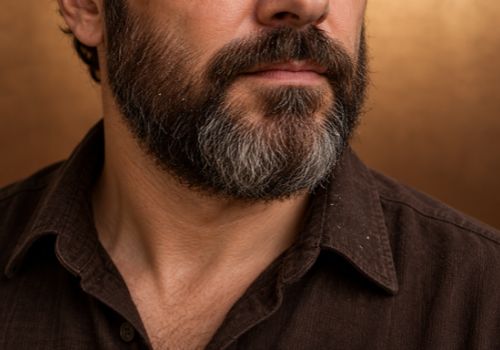
A beard can hide the skin, but it doesn’t make skin problems disappear. If something feels wrong underneath, check the cause before adding another layer of product.
| Problem | What to do |
| Itching or irritation | Simplify your routine, cleanse gently, and stop products that sting or appear to trigger irritation. Seek advice if it persists. |
| Flakes or greasy scales | Don’t assume it’s just dryness. Persistent scaling may need assessment for conditions such as seborrheic dermatitis. |
| Breakouts | Reach the skin when cleansing, rinse thoroughly, and choose non-comedogenic products. Avoid picking or trimming directly over raised spots. |
| Tangles and rough-feeling hair | Check your conditioning routine and comb gently from the tips upward. Avoid forceful brushing. |
| Naturally uneven growth | Work with your coverage when choosing the shape. A barber can help balance the outline. |
| New, smooth bald patches | Arrange a dermatologist’s assessment rather than relying on cosmetic growth products. |
Persistent beard rash, painful bumps, broken skin, or sudden hair loss deserve professional attention. The AAD’s guide to common beard problems explains why different symptoms may need different approaches.
Weekly Maintenance: Keep the Shape Under Control
Set aside a few minutes each week to inspect your beard. Trim according to its growth and your preferred style—you don’t need to cut simply because it’s maintenance day.
- Check all angles: Assess the front, both sides, and underneath before picking up your tools.
- Review the proportions: Look for excess cheek width, an overly pointed bottom, or uneven fullness.
- Clear the lip: Tidy moustache hairs that interfere with eating, drinking, or your chosen style.
- Maintain the borders: Check the cheek lines, neckline, and sideburn transitions without gradually shifting them.
- Clean your equipment: Remove trapped hairs and clean attachments according to the manufacturer’s instructions.
- Check the skin: Look for persistent irritation, flakes, or bumps beneath the beard.
If you shave your head, include the sideburn transitions in this review so the scalp and beard continue to work together.
When a Barber Can Help
Consider a barber when establishing your medium beard’s shape, changing styles, or struggling to balance the sides.
Explain how much length you want to keep, which areas bother you, and how much maintenance you’re willing to do at home. If you bring a reference photograph, discuss how its shape might work with your own coverage and texture.
Before leaving, ask:
- Which areas should I trim at home?
- Which areas should I leave to grow?
- Where should I maintain the cheek and necklines?
- Which guard lengths—or scissor techniques—suit this shape?
- How should the sideburns finish?
- If I want to color my beard at home, which shade, products, and application techniques would you recommend?
A clear outline gives you something to follow—so your next touch-up doesn’t become an accidental return to stubble.