Collagen for Men Over 40: A Men’s Guide

Collagen for men over 40? It used to be something associated mainly with women and their beauty routines. But is it really something only women can benefit from?
Now collagen appears to be everywhere — in powders, drinks, supplements, gyms, and increasingly in products aimed specifically at men.
The promises sound great, especially once you hit 40: healthier joints, stronger tendons, better recovery, younger-looking skin, stronger bones, and even more muscle.
But does taking collagen actually deliver what it promises, or has the marketing simply found a new audience?
We’ll answer the question that really matters: is collagen actually worth your money?
What Is Collagen — and Why Do Men Need It?
Collagen is the most abundant protein in the human body. Think of it a bit like the cement in a building — it helps hold the structure together, giving strength and support to everything from your skin and bones to your tendons, ligaments, and cartilage.
And despite its long association with beauty products, collagen certainly isn’t just a women’s thing. Men rely on it just as much.
Your body makes collagen naturally using amino acids from the protein you eat, along with nutrients such as vitamin C. But collagen isn’t all the same. There are more than 20 different types, although a handful make up most of the collagen in your body.
For this guide, these are the three you’re most likely to come across:
| Collagen Type | Where you mainly find it |
| Type I | Skin, bones, tendons and ligaments |
| Type II | Cartilage |
| Type III | Skin, muscles and blood vessels |
This is why you’ll see different types advertised on collagen supplements. A product aimed at supporting joints, for example, may contain a different form of collagen from one marketed for skin.
But whatever type of collagen you see advertised, your body already makes it itself.
So the real question isn’t whether men need collagen — they do. It’s whether taking collagen as a supplement provides any additional benefit.
What Happens to Collagen After 40?
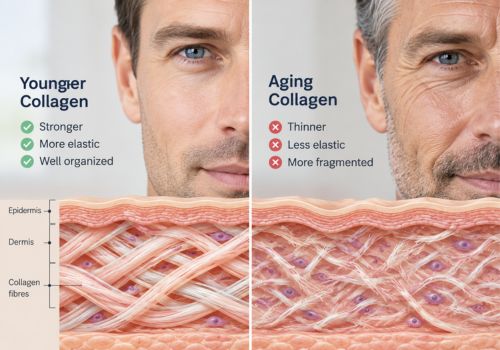
Nobody suddenly switches off your collagen production when you turn 40, but your body’s ability to make new collagen gradually starts to slow down with age.
So what happens? Your collagen-producing cells become less active, while the collagen already in your tissues can become more fragmented and less well organized. Over time, this contributes to some of the changes we associate with getting older.
Your skin becomes less firm, joints and connective tissues may feel less forgiving, and tendons can take longer to adapt and recover.
But age isn’t the only thing working against your collagen, either. Your collagen production is also fighting against years of sun exposure, smoking, poor nutrition, excessive alcohol, inactivity, metabolic issues, and repeated stress or injury to your connective tissues.
If you’re over 40—especially if you’ve been working out for years—you might start noticing a shift. You’re still lifting the same weights or pushing through your usual workouts, but now your knees ache a bit more, an old injury flares up, or recovery just takes longer than it used to.
None of this automatically means that you’re “low in collagen” or that you need a collagen supplement. Aging is far more complicated than that.
This explains why researchers are looking into whether collagen supplements—or the building blocks used to make collagen—can help support aging joints and connective tissues.
Does Collagen Actually Work for Men Over 40?
Collagen for Joints and Cartilage
If your knees have started squeaking or cracking every time you squat, run, or walk downstairs — and they start to ache a little more than they used to — you’re probably starting to look for a solution.
And this is actually one area where the research looks fairly promising.
A 2025 review found that collagen supplementation improved joint pain and function in people with knee osteoarthritis.
And there´s more: another trial showed that adults with knee or hip discomfort who took a daily dose of 5 grams of collagen peptides for 12 weeks had less discomfort during everyday movements such as walking, climbing stairs, kneeling, and squatting.
The results sound encouraging, although studies have used different types and amounts of collagen, so we still don’t have all the answers.
So does this mean collagen can rebuild worn-out cartilage and give you the knees you had at 25?
Unfortunately, no.
The bottom line is, if aching or stiff joints are why you’re considering collagen, there is some genuine research behind it. Collagen may help with joint discomfort and movement, but don’t expect it to magically rebuild damaged cartilage or undo years of wear and tear.
Collagen for Tendons and Ligaments

If you’ve been working out for years, you may find that it’s not your muscles holding you back anymore; maybe it’s the aching shoulder or a dodgy Achilles tendon that decides to play up.
Tendons and ligaments contain a lot of collagen, and research suggests that taking collagen peptides alongside exercise may help strengthen and support your tendons, although we still need more research. Collagen on its own isn’t going to repair an injured tendon while you sit on the sofa.
And it’s not just your joints. Collagen also forms an important part of your bones, and some research suggests collagen supplements may help support bone strength and density as you age, although much of this research has been carried out in women.
The bottom line is, collagen may provide some extra support for tendons and ligaments, especially if you train regularly or are recovering from an injury. But think of it as a possible addition to proper training and rehabilitation — not a replacement for them.
Can Collagen Help Build Muscle?
Collagen is a protein, so it’s easy to assume that taking it will help you build muscle, but does it?
For your muscles to grow and repair, they need certain amino acids, in particular leucine. Although collagen contains plenty of amino acids, it’s relatively low in leucine and doesn’t contain enough of all the essential amino acids your muscles need.
The bottom line is, collagen might have benefits elsewhere in your body, but if bigger or stronger muscles are your main goal, don’t swap your regular protein for collagen.
Collagen vs Whey Protein
| If your goal is… | Better choice |
| Building and maintaining muscle | Whey or another complete protein |
| Supporting joints and connective tissues | Collagen may be useful |
| You want both | You don’t necessarily have to choose one or the other |
Does Collagen Help Men’s Skin or Hair?

Yes, men get wrinkles too; it’s not a prerogative of women.
With age, your collagen levels change, and your skin gradually becomes thinner, less elastic, and more prone to wrinkles. Years of sun exposure can speed up this process, particularly if sunscreen hasn’t exactly been part of your daily routine.
So can taking collagen actually make a difference?
Absolutely. Research has found that collagen supplements can improve skin hydration and elasticity and may also help reduce wrinkles, so you don´t end up looking like a dried-up prune.
Before you get overly excited, let’s make one thing clear though: The changes aren’t dramatic, and collagen certainly isn’t going to turn back the clock by 20 years.
And if you’re spending money on collagen while regularly heading outside without sunscreen, you’re probably putting your money on the wrong horse. UV exposure is one of the biggest contributors to collagen breakdown and premature skin aging.
So what about your hair and nails? Unfortunately, despite some clever collagen marketing campaigns, there’s currently little good evidence that collagen supplements can prevent or reverse male-pattern hair loss. There is some limited evidence that collagen may help brittle nails, but don’t expect miracles.
The bottom line is, collagen may give aging skin some extra support, but think small improvements rather than a new face. And whatever you do, don’t forget the sunscreen.
So, Does Collagen Actually Work?
| What do you want it for? | Does it help? | Main collagen type involved | Evidence |
| Joint pain & stiffness | Yes, it may help | Type II* | ⭐⭐⭐⭐☆ |
| Tendons & ligaments | Maybe, especially with exercise | Type I | ⭐⭐⭐☆☆ |
| Building muscle | Not really | Types I & III are present in muscle/connective tissue, but collagen isn’t an ideal muscle-building protein | ⭐⭐☆☆☆ |
| Skin hydration & elasticity | Yes, with regular use | Types I & III | ⭐⭐⭐⭐☆ |
| Fine Lines & Wrinkles | Yes, but results depend on how deep the lines are | Types I & III | ⭐⭐⭐⭐☆ |
| Bone health | Possibly | Type I | ⭐⭐⭐☆☆ |
| Hair loss | No | — | ⭐☆☆☆☆ |
| Brittle nails | Minimal | Type I | ⭐⭐☆☆☆ |
Evidence score: ⭐ = little or no good evidence | ⭐⭐⭐⭐⭐ = strong and consistent human evidence.
- The collagen type naturally found in a tissue isn’t necessarily the only type of collagen supplement that has been studied for that benefit.
What Kind of Collagen Should You Take?
Shopping for collagen can get confusing pretty quickly. You’ll see collagen peptides, hydrolyzed collagen, bovine collagen, marine collagen, and gelatin, often with each claiming to be the better choice.
Here’s a simple guide as to what those terms actually mean:
| What you’ll see | What is it? | Good to know |
| Collagen peptides | Collagen broken down into smaller pieces | Easy to mix and commonly used in supplements and research |
| Hydrolyzed collagen | Essentially another name for collagen peptides | Don’t pay extra just because the label says “hydrolyzed” |
| Bovine collagen | Usually collagen sourced from cattle | Typically rich in Types I and III and widely available |
| Marine collagen | Usually collagen sourced from fish | Mainly Type I; often more expensive and not automatically better |
| Gelatin | Collagen that has been partially broken down | Contains similar amino acids but behaves differently in food and liquids |
Tip: Don’t get too hung up on the fancy terminology. For most people, a reputable collagen peptide or hydrolyzed collagen product is the simplest place to start.
How Should You Take Collagen?
Different collagen products contain different amounts per serving, so the simplest approach is to follow the recommended serving on the product and not exceed the recommended amount. Taking more doesn’t necessarily mean you’ll get better results.
There isn’t a magic time of day to take collagen — consistency matters more than the clock.
And don’t expect results overnight — Most collagen studies run for several weeks or months; it’s a long-term investment, so if you’re going to try it, be patient.
The good news is that researchers found that some skin benefits were still present four weeks after supplementation stopped in women who took collagen peptides daily for 12 weeks.
Collagen supplements are generally well tolerated, although some people may experience bloating, nausea, or digestive discomfort. Also check where your collagen comes from — particularly if you have fish, shellfish, or other food allergies. If you have kidney disease or another medical condition that requires you to limit protein, check with your doctor before taking a collagen supplement.
Do You Need Vitamin C With Collagen?
Vitamin C plays an important role in your body’s natural production of collagen, which is why you’ll sometimes see it added to collagen supplements.
If you’re buying a collagen supplement, choosing one that already contains vitamin C makes sense. It saves you having to think about getting enough vitamin C alongside it, and there’s no need to buy a separate vitamin C supplement.
The Lillepin Takeaway
So, is collagen worth taking after 40?
For some things, yes. For others, the marketing is way ahead of the science.
The best evidence is for supporting joints, tendons and skin, particularly when collagen is taken consistently over time. It may also offer some support for your bones, while the evidence for things like hair loss and building muscle is much less convincing.
If you decide to try it, choose a reputable collagen peptide or hydrolyzed collagen supplement that contains vitamin C, follow the recommended serving, and give it a few months before deciding whether it’s doing anything for you.
And remember, collagen is a supplement — not a replacement for good nutrition, exercise, sunscreen, or a decent protein intake.
Is it a miracle powder? No. But for the right reason, it may actually be worth the scoop.
Related Lillepin Research
NS-023 → Read the full article: Creatine After 40: Could It Protect Your Muscles and Boost Your Brain?
P1-098 → Read the full article: Could One Workout a Week Be as Effective as Three?
P4-003 → Read the full article: Can Collagen Really Make Your Skin Firmer?