Your Ovaries Don’t Just Control Periods

Ovaries and Menopause: 7 Metabolic Shifts That Change More Than Your Period
Ovaries and menopause are often discussed only in the context of fertility. Many women associate their ovaries almost exclusively with reproduction. They become a topic during puberty, are closely monitored when pregnancy is desired, and then quietly fade from the conversation once reproduction is no longer the focus.
But biology tells a very different story.
Long before menopause officially begins, the ovaries act as powerful signaling centers, influencing far more than the menstrual cycle. Through estrogen and progesterone, they remain in constant communication with the brain, metabolism, bones, skin, and nervous system. These signals help regulate energy, emotional resilience, sleep quality, tissue repair, and even how the body responds to stress.
In many ways, the ovaries function less like a simple on–off switch and more like the conductor of an orchestra. They do not perform every task themselves, but they coordinate timing across multiple systems. When that signaling gradually changes — sometimes years before menopause is recognized — the effects can appear in unexpected places.
Sudden fatigue, brain fog, shifting mood, stubborn weight changes, or sleep disruption often feel unrelated at first. These changes are frequently blamed solely on declining estrogen levels. Yet estrogen does not operate independently. It is the ovaries that regulate and initiate these hormonal shifts. What many women experience is not a single hormone “failing,” but a broader adjustment in ovarian communication.
Reproductive milestones may also reveal something about long-term health, with recent research examining whether the timing of menopause and the length of the reproductive lifespan are connected with biological aging.
Understanding this larger role can transform how menopause is viewed — not as a single event driven by one hormone, but as a whole-body transition shaped by one of the body’s most influential communication hubs.
Table of Contents
Ovaries and Menopause: The Myth That They Only Matter for Fertility

For generations, conversations about the ovaries have focused almost entirely on reproduction. In school education, they are introduced as organs responsible for releasing eggs and regulating the menstrual cycle. During the reproductive years, they often reappear in conversation when pregnancy becomes a goal — or when something goes medically wrong. Outside of these moments, their broader role in everyday health is rarely discussed.
This narrow focus has quietly shaped how many women understand menopause. When fertility ends, it can seem logical to assume that the ovaries simply “switch off,” leaving the rest of the body largely unchanged.
As a result, symptoms that appear during midlife are often viewed as separate problems — poor sleep, mood fluctuations, weight gain, or joint discomfort — rather than parts of the same transition. It can feel a little like watching the hands of a clock move without seeing the mechanism connecting them. Each change appears independent, even though they rely on one another for the system as a whole to function.
In reality, the ovaries are part of a complex endocrine network that communicates continuously with other organs and systems. Through the regulation of hormones such as estrogen and progesterone, they influence how the brain processes stress, how muscles recover after activity, how bones maintain strength, and how efficiently the body manages energy.
Importantly, this communication does not begin or end with menopause itself. Hormonal signaling naturally evolves, often years before periods become irregular. Many women notice subtle shifts in concentration, sleep patterns, emotional tolerance, or recovery long before recognizing these experiences as part of a hormonal transition.
Rather than a sudden shutdown, menopause is better understood as a gradual recalibration — one in which the ovaries adjust how signals are sent throughout the body. What may feel like unrelated frustrations are often different expressions of the same underlying shift.
Recognizing this connection does not mean every symptom has a single cause. Lifestyle, stress, nutrition, and overall health all play important roles. However, acknowledging the ovaries as active regulators helps explain why multiple systems can change at the same time — and why supporting the body holistically often leads to better results than addressing each symptom in isolation.
Your Brain Listens to Your Ovaries
If your focus, patience, or emotional tolerance has shifted in midlife, it may not be your imagination.
The brain is one of the most hormone-sensitive organs in the body. Estrogen and progesterone do far more than regulate the menstrual cycle — they influence neurotransmitters that shape attention, motivation, memory, and mood. When ovarian signaling begins to change, the brain often feels it first.
Estrogen plays an important role in supporting dopamine activity. Research shows that estrogen strongly influences neurotransmitter systems — including dopamine and serotonin pathways linked to focus, motivation, memory, and mood regulation. Dopamine helps initiate tasks, sustain attention, and maintain motivation. It is also closely involved in executive function — the ability to plan, prioritize, and regulate emotional responses.
As estrogen levels fluctuate or gradually decline, dopamine signaling may become less efficient. Tasks that once felt manageable may suddenly require more effort. Distractions feel louder. Emotional reactions feel closer to the surface.
This does not mean the brain is failing or that something is medically wrong.
It simply means the chemistry supporting focus and resilience is adjusting.
Estrogen also interacts with serotonin, a neurotransmitter closely linked to mood stability and sleep quality. Many women notice that sleep becomes lighter or more fragmented during perimenopause, even before hot flashes begin. When sleep quality declines, concentration and emotional regulation become more vulnerable, creating a cycle that can feel difficult to break.
Ovarian signaling also influences the nervous system. Estrogen and progesterone help regulate how the body responds to stress and how efficiently it returns to calm afterward. When signaling shifts, the stress response may feel amplified. Situations that once felt manageable can suddenly feel overwhelming, and recovery after difficult days may take longer.
For some women, these changes feel surprisingly familiar. Long-standing patterns — difficulty switching between tasks, emotional sensitivity, or relying on pressure to stay focused — may feel more intense. For women navigating Menopause and ADHD, this shift can feel especially intense.
In many cases, this is not a sudden decline in ability, but a change in hormonal support. The brain continues to learn and adapt — but now with different inputs.
Brain fog, forgetfulness, or moments of confusion often reflect adjustment rather than permanent loss.
Understanding this connection can be profoundly reassuring because the brain is only one part of a larger system influenced by ovarian signaling.
Metabolism, Energy & Weight: Why Your Body Suddenly Feels Different

Many women enter midlife convinced that something has gone wrong with their metabolism.
Foods that once felt neutral suddenly lead to weight gain. Energy crashes appear without warning. Sleep no longer restores the body in the same way it once did. Even motivation can feel unreliable.
It is easy to assume this is simply aging.
But your ovaries have quietly influenced metabolism for decades — far beyond reproduction.
Whether menopause begins later than expected or earlier in midlife, changes in ovarian hormone signaling can reshape how the body manages energy. Timing may differ from woman to woman, but the biological conversation remains similar.
When ovarian signaling begins to change, the body does more than adjust cycles. It recalibrates how energy is used, stored, and protected.
Understanding this shift can transform frustration into clarity.
Estrogen: The Hidden Metabolic Organizer
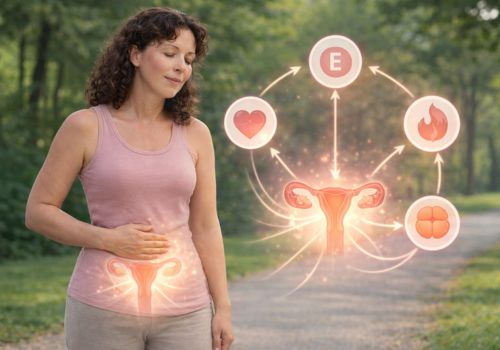
Estrogen helps regulate glucose handling, insulin sensitivity, fat distribution, and muscle maintenance.
It supports:
- stable blood sugar responses
- healthy insulin signaling
- mitochondrial energy production
- muscle repair and recovery
- appetite signaling within the brain
When estrogen fluctuates during perimenopause, these systems may temporarily lose coordination.
Metabolism has not stopped working.
The rules are simply changing.
Many women notice abdominal weight gain, stronger cravings, afternoon exhaustion, slower recovery after exercise, or increased stress sensitivity.
These experiences are not failures of discipline.
They are physiological responses to hormonal recalibration.
Why Weight Often Shifts Toward the Abdomen
Fat storage patterns often change during menopause.
Where weight once settled around hips or thighs, it may suddenly move toward the abdomen.
Estrogen previously helped guide fat distribution. As levels decline, the body becomes more sensitive to cortisol — the primary stress hormone.
From an evolutionary perspective, abdominal fat provides rapid energy access during perceived instability.
The body is not sabotaging you.
It is protecting energy availability.
Chronic stress, poor sleep, inflammation, and blood sugar instability can amplify this effect.
Restriction increases stress signaling.
Support restores balance.
Energy Isn’t Just Calories — It’s Communication
Many women experience fatigue during menopause that feels different from ordinary tiredness.
Sleep may appear adequate, yet energy remains low.
Motivation fluctuates.
Simple tasks require more effort.
Estrogen helps support mitochondrial efficiency — the cellular structures responsible for producing energy. Research on ovarian aging also highlights how closely ovarian function is tied to cellular energy metabolism.
When signaling changes, energy production may temporarily become less efficient, especially under stress.
At the same time, nervous system load often increases.
Career demands, caregiving responsibilities, emotional transitions, and sleep disruption frequently converge during midlife.
For women with ADHD, this shift can feel even more pronounced. Estrogen supports dopamine signaling, which influences focus, motivation, and emotional regulation. As hormones fluctuate, attention may feel harder to sustain and emotional responses more intense.
This does not mean ADHD has worsened.
The neurological environment supporting regulation is changing.
When your body feels overwhelmed for a long time, it switches into “energy-saving mode.”
Fatigue becomes protection rather than weakness.
Why Extreme Diets Often Backfire in Midlife
Many women respond to weight changes by eating less or exercising harder.
Earlier in life, this may have worked.
During menopause, it can increase exhaustion.
Aggressive calorie restriction raises cortisol.
High-intensity exercise without recovery increases nervous system strain.
Long periods of fasting can also become counterproductive for some women. Extended fasting may increase stress signaling, disrupt sleep, or intensify cravings when hormones are already fluctuating.
This does not mean fasting has no place in midlife.
Many women find that a structured rhythm — such as a balanced 16:8 fasting window — supports blood sugar stability without adding stress.
The difference often lies in support rather than extremes.
In midlife, the question is not how long you can go without eating, but whether your body feels safe enough to use energy efficiently.
A Different Kind of Strength
Midlife metabolism asks for a quieter resilience.
Not constant pushing.
But strategic support.
Muscle protects bone health, glucose regulation, and independence.
Recovery becomes as important as effort.
Consistency matters more than intensity.
Many women discover that when they stop fighting their bodies and begin understanding these signals, energy stabilizes again.
Weight management becomes less about willpower and more about alignment.
Because nothing is broken.
Your body is simply asking for a different conversation.
The Ovaries as a Regulatory Organ
It can be tempting to view menopause as the moment ovarian function simply ends.
In reality, what changes is communication.
For decades, the ovaries have acted within a regulatory network coordinating stress response, tissue repair, metabolism, and resilience.
Sleep may change.
Mood may shift.
Recovery may slow.
Weight distribution may evolve.
These experiences can feel unrelated at first.
Yet they often reflect the same adjustment — the body learning to function with different hormonal guidance.
This is why menopause can affect systems that seem unrelated at first glance.
Estrogen and progesterone influence inflammation, cardiovascular health, bone remodeling, metabolism, and nervous system stability. As ovarian signaling recalibrates, these systems rely more heavily on lifestyle support, nutrition, sleep, muscle strength, and emotional regulation.
This does not mean the body becomes fragile.
Responsibility simply shifts.
Where hormones once carried much of the regulatory work automatically, daily habits begin to play a larger role in maintaining resilience.
In recent years, researchers have begun using the term ovarian longevity to describe the broader impact of ovarian aging on long-term health. Rather than viewing the ovaries solely through a reproductive lens, this emerging field positions ovarian aging as a reflection of broader metabolic, neurological, and inflammatory processes across the lifespan.
From this perspective, menopause is not simply the end of fertility. It represents a neurological and metabolic inflection point — a transition in how the body coordinates energy, stress, and repair.
Timing varies widely between women. Some experience these adjustments earlier, while others notice them later in life. Regardless of timing, menopause reflects adaptation rather than failure.
Seen through this lens, menopause becomes less about loss and more about transition.
The ovaries are not switching off.
They are stepping back from a central coordinating role — allowing other systems to take the lead.
Menopause is often described as an ending.
In reality, it is a shift in leadership within the body.
The ovaries may no longer coordinate every system the way they once did, but the body remains capable of adaptation, strength, and renewal.
Nothing is broken.
The conversation is simply changing.
Related Lillepin Research
P1-049 — Scientists Finally Start to Understand Menopause Brain Fog
A 2026 Lancet review explores how menopause may influence memory, attention, focus, and mental clarity during midlife.
→ Read the full article Scientists Finally Start to Understand Menopause Brain Fog
P2-044 — Could Your Gut Influence Estrogen? New Research Suggests It Might
A 2026 PNAS study suggests the gut microbiome may play a larger role in estrogen recycling and hormone regulation than previously understood.
→ Read the full article: Could Your Gut Influence Estrogen? New Research Suggests It Might
P1-054 — Scientists Discover a Surprising Connection Between Your Bones and Your Brain
A 2026 Biomolecules review explores the emerging bone-brain axis, suggesting that bone health and brain function may be connected through hormones, inflammation, immune signaling, neurotransmitters, and stress-related pathways.
→ Read the full article Scientists Discover a Surprising Connection Between Your Bones and Your Brain
P2-040 — Your Gut Does Not Stay the Same After Menopause
New research shows that menopause changes the gut microbiome, reducing bacterial diversity and altering microbes involved in estrogen metabolism, inflammation, and metabolic health. Scientists believe these changes may contribute to many common menopause symptoms and could play an important role in healthy aging.
→ Read the full article: Your Gut Does Not Stay the Same After Menopause.
P4-015 — Could Your First Period and Menopause Predict How You Age?
A 2026 study examined whether reproductive milestones—including age at first period, age at menopause, pregnancies, live births, and reproductive lifespan—were associated with biological aging measured using DNA methylation clocks.
→ Read the full article: Could Your First Period and Menopause Predict How You Age?